 AI writing
Why AI blog posts feel generic for businesses, and how verified company facts, source material, search intent, and brand guidance can make them specific.
10 min read

You open an AI-generated blog draft, read three smooth paragraphs, and realize a competitor could publish the exact same page. The sentences flow cleanly, yet nothing on the screen reflects your product, your customers, or your hard-won expertise.
You may ask yourself why AI blog posts sound generic for my business when the writing looks polished on the surface. In our editorial work, we see that flat drafts rarely come from weak grammar. They come from missing inputs.
Changing a few adjectives or asking the tool to sound livelier will not fix an empty brief. Below, we show you how to trace generic phrasing back to four specific gaps: business context, source material, search intent, and brand guidance.
Article summary
AI drafts sound interchangeable when you supply a broad topic without verified company facts, a defined reader, or a clear task. Without those boundaries, the software fills every paragraph with safe industry averages.
Understanding why AI blog posts sound generic for a business starts with how a large language model works. A large language model is software trained on vast collections of text to generate new sentences from patterns.
Google Search Central updated its generative AI guidance on October 1, 2026. It explains that generative models predict likely word sequences from training data instead of retrieving verified facts. Because the system predicts common wording, outputs can be inaccurate and require manual fact-checking.
In business blogging, generic AI writing is content that lacks verifiable details about a specific company, audience, or area of expertise. You could move that draft onto another company's website with almost no edits.
Many business owners assume Google penalizes a page simply because AI helped draft it. Google's published Search policy focuses on accuracy, relevance, and value for the reader. It warns that producing scaled content without user value may violate its scaled content abuse spam policy.
Giving an AI tool a broad topic is like handing a freelance writer a subject line with no company brief or product sheet. The writer must guess what you sell and who you serve. As a result, the draft defaults to safe advice anyone could write.
When every competitor uses similar prompts, the resulting posts converge on the same talking points. Research into making AI drafts distinctive shows that original evidence and human review separate useful articles from routine summaries.
A 2024 experiment by Anil Doshi and Oliver Hauser, published in Science Advances on July 12, 2024, illustrated this pull toward sameness. In their study, 293 writers produced eight-sentence stories, and AI-assisted stories grew more similar to one another than stories written without AI ideas.
That experiment measured short creative fiction, so it does not prove a specific business-blog outcome. Even so, it highlights a practical trade-off: AI ideas improved some individual story ratings while reducing collective variety across writers.
Clean grammar often fools busy teams into publishing drafts that fail their readers. A paragraph can read effortlessly while saying nothing verifiable about your product, pricing structure, or service limits.
Following a human-led AI writing process helps teams catch weak claims before publication. Without structured review, AI-assisted business blogging introduces five main risks:
An AI model cannot know your service boundaries, internal processes, or customer objections unless you place those records in the prompt. Start every blog assignment by collecting verified details from your own company files.
Google Search Central updated its people-first guidance on October 5, 2026. It asks whether a page offers original information or analysis, serves an intended audience, demonstrates first-hand expertise, and provides clear sourcing. Grounding your brief in real customer pain points directly supports those criteria.
Think of company context as a reference folder you hand over before writing begins. Pairing that folder with accurate search intent analysis keeps the draft tied to what buyers actually need. Gather these six items from your business records before generating another draft:
Collecting these details takes twenty minutes up front, yet it eliminates hours of rewriting later. The trade-off is simple: slower preparation produces fewer empty paragraphs.

A source acts as the receipt for a claim. Even when a sentence reads smoothly, any fact without a clear origin still requires verification before you publish it.
Consider an illustration from a regional commercial roofing company in Ohio. If the owner prompts an AI tool for a post on flat roof inspections, the draft will likely repeat standard advice about checking drains and clearing leaves.
Now suppose the owner adds two pages of internal inspection notes covering how freeze-thaw cycles crack membrane seams around rooftop vents. Suddenly, the draft explains a specific failure point the contractor actually repairs.
Whenever a draft needs proof you do not have on file, ask an internal subject expert or consult your support tickets and service logs. Never ask the AI tool to invent a customer case study or estimate an unverified metric. If you cannot verify a claim, remove it from the brief.
Accurate company facts still fail when the article answers the wrong question. This mismatch is another major reason why AI blog posts sound generic for a business even when the facts are right.
Search intent is the practical assignment the reader wants to finish after typing a query. If a buyer wants a troubleshooting checklist and your post delivers a broad definition, the reader leaves.
Google Search Central updated its AI optimization guide on July 10, 2026. It recommends publishing useful, non-commodity content with a distinct point of view. It also clarifies that you do not need a special writing format solely for generative AI search, nor should you build a separate page for every query variation.
Aranx analyzes a business website, competitors, and live search results to identify content gaps and ground article planning in the business's positioning. Before generating a draft, run this four-step intent check in order:
A broad topic label gives an AI writer too many directions at once. Writing about "payroll software" invites definitions of gross pay, tax filings, and direct deposit that experienced operations managers already know.
Replacing that label with a narrow problem changes the entire outline. For example, a brief might target a finance manager at a forty-person agency who needs to track contractor invoices across two states without late-filing penalties.
When you define one concrete reader task, every section has a clear filter. Any paragraph that fails to move that reader closer to a decision gets cut before editing begins.
Live search results show how readers prefer to consume an answer. Some queries return step-by-step troubleshooting guides, while others return side-by-side comparisons or diagnostic checklists.
We recommend treating top-ranking pages as structural clues for format and depth. Avoid feeding competitor paragraphs into your prompt as source material, because summarizing rival pages produces derivative content.
Instead, notice what existing pages leave unanswered for your segment of the market. Fill that gap with your own service criteria, operational constraints, or documented customer questions.
Brand voice instructions tell the model how your business communicates, while company records supply the factual evidence. Keep those two inputs separate in every prompt.
A common mistake is trying to fix thin content by adding stronger style adjectives. Telling a model to write with authority cannot invent product specifications, pricing rules, or first-hand experience.
OpenAI's prompt engineering documentation identifies four useful prompt components: identity, instructions, examples, and context. It advises adding relevant proprietary context outside a model's training data, showing concrete style examples, and running evaluation checks as you iterate.
To write a blog post with AI that fits your website, specify the reader and goal, supply verified company facts, show voice examples, request a clear structure, and review the draft manually. Include these five elements explicitly in your prompt:
Adjectives like "friendly", "modern", or "expert" mean different things to different readers. A model interprets those labels loosely and often defaults to stiff, promotional phrasing.
Concrete writing samples give the model an exact target. Paste two or three short paragraphs from a help article, founder memo, or proposal that already reflects how your team speaks to clients.
Pair those samples with a short list of banned phrases and preferred product terms. Building this reusable voice packet requires an hour of review once, yet it saves editing time on every future article.
When you update a prompt, test it on one section before regenerating the full article. Change a single input at a time, such as adding product constraints or swapping voice samples, so you can see what caused the improvement.
Read the original and revised paragraphs side by side. Check whether the new version names real company processes, respects your claim limits, and answers the reader's task directly.
Avoid mistaking a punchier opening sentence for stronger substance. A revision succeeds only when each key claim traces to evidence you can defend if a customer asks about it on a sales call.
Once you know why AI blog posts sound generic for your business, you can stop polishing weak sentences by hand. Audit one draft paragraph by paragraph and match the symptom to the right next step.
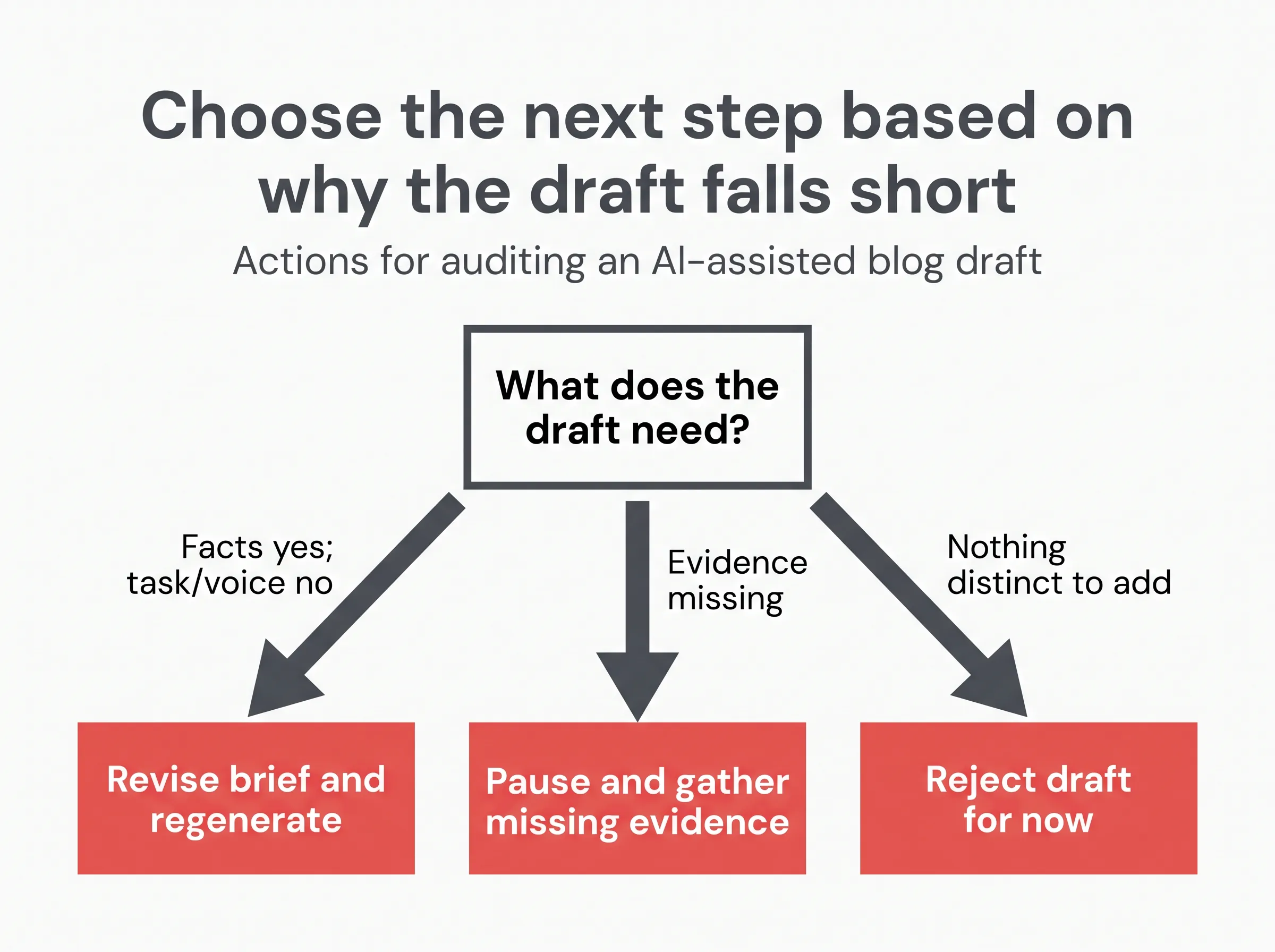
Ask three questions of every main section: does it rely on a verified company fact, does it solve the intended searcher's task, and does it reflect your approved voice? Your answers point to one of three actions:
Open your most recent unpublished draft today and highlight every sentence that could sit on a competitor's site unchanged. Gather the one missing input behind those highlights, update your brief, and test a single rewritten section before approving the full post.
To write a blog post with AI, specify the intended reader and goal, provide verified company facts and relevant sources, and include examples of the voice you want. Request a clear structure, then check the draft for factual accuracy and original value before using it.
Five risks of AI-assisted business blog writing are factual errors, unsupported product claims, generic or derivative text, a poor fit for the intended audience, and low-value content produced at scale. Google’s 2026 guidance calls for accuracy, relevance, originality, and manual review, and warns that scaled content without user value may violate its spam policy.
In business blogging, generic AI writing is content that lacks verifiable details about a particular company, audience, or expertise, so it could be moved to another company’s site with little change. A broad topic without those distinguishing inputs can leave a draft fluent but interchangeable.
AI blog posts can sound generic for your business because a broad topic prompt may give the model too little verified information about your company, audience, expertise, the reader’s task, or your voice. The draft can still read smoothly, but without inputs that distinguish your business, its claims may be interchangeable with competitors’.

